
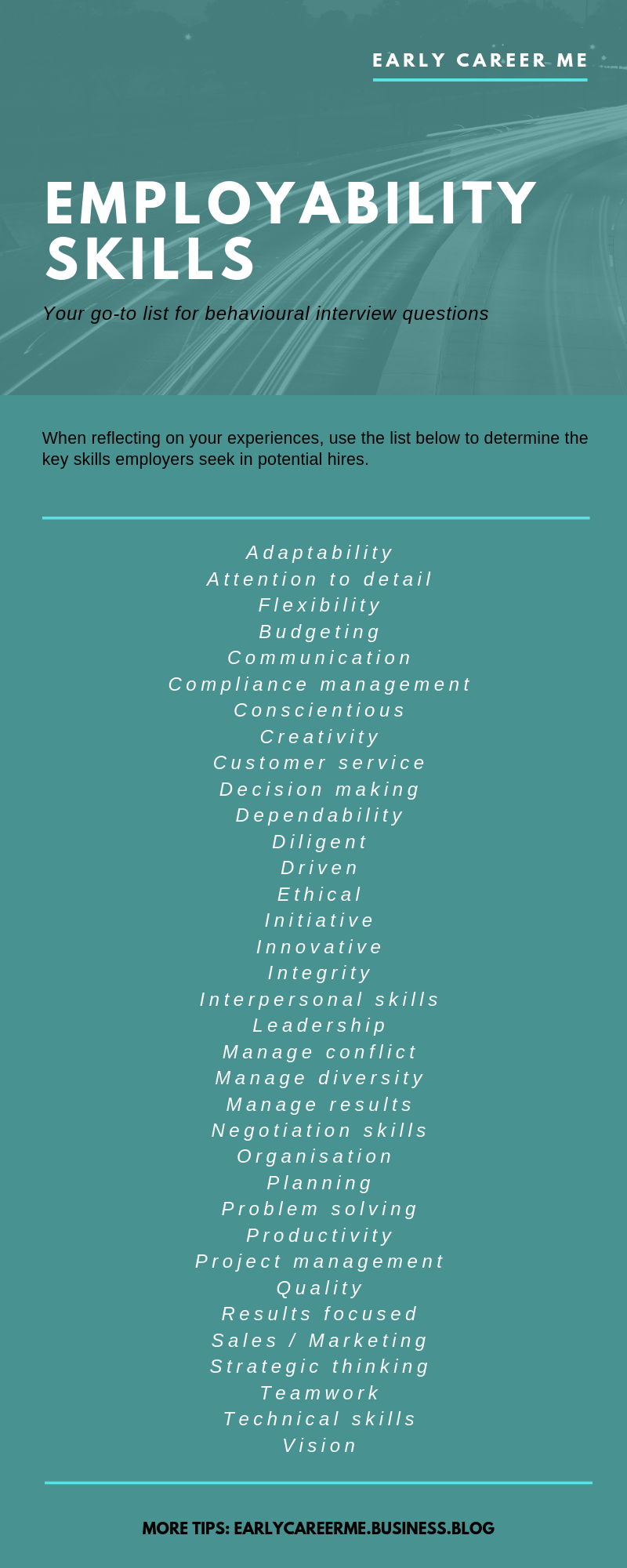
Employability Skills
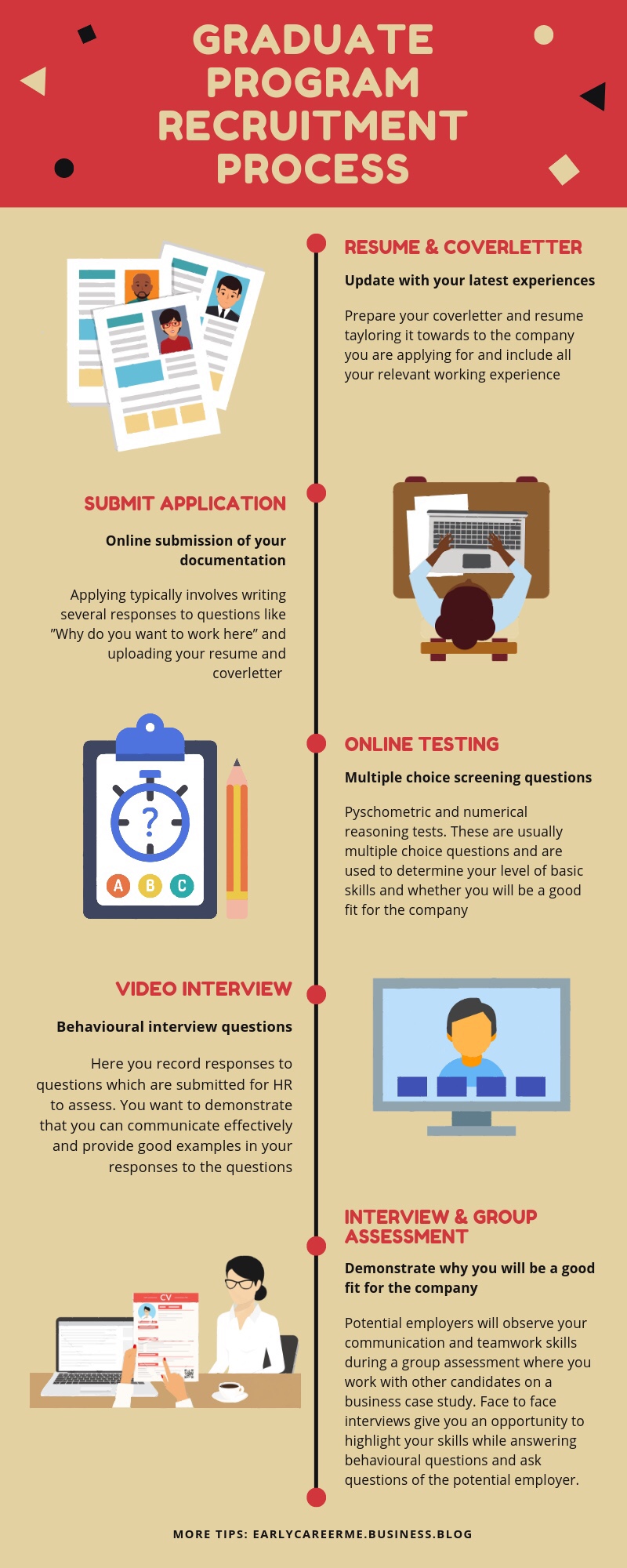
Today I’m sharing from my experience the graduate recruitment process for the business / commerce industry. The actual process depends on the size of the company and how many applicants they have. Generally the more applications, the more steps required to filter out the best candidates. Companies might hire on a rolling basis – this means that they start reviewing and processing applications when they are received, rather than waiting to the deadline date for submission, so it is always a good to submit your applications early.
The time for the whole process to go from start to end depends on the company, often it can be a couple of weeks before you move through each stage, especially at the initial stages of testing and video interview stage as it takes human resources (HR) a while to go through all their applications. In Australia the majority of the big companies open their applications around March and April, and these are usually for positions in the following year. E.g. applied in March 2019, got an offer in April 2019, will start work in January 2020.

If you have started to prepare for graduate program interviews, it is likely that you have already come across the STAR technique. This post is a quick-guide to get you started with the STAR technique
In this article we will cover the following:
The STAR technique is a method to help you structure answers for behavioural interview questions, which include questions like “Tell me about a time you showed initiative“.
The benefit of using the technique is that it forces you to use an example from your past experience to answer the question, rather than make a generic statement like “I work hard and am a creative team player”.
In behavioural interview questions, the interviewer wants to know how you have shown the particular trait in the past, which provides an indication of how you will perform in the future.
STAR is a valuable tool because often large companies, like the Big 4 Accounting firms, encourage graduate applicants to answer interview questions using the STAR structure.
The STAR structure
Situation: what was your role or responsibility?
Task: what did you do in this specific example?
Actions: what actions did you take to complete or solve the task?
Result: what were the results of your actions?
Here is an example of how I would apply to the STAR structure to one of my experiences from university. Other student STAR examples can be found here.

Some things to consider when writing your STAR examples;
How do I choose my examples? How many examples should I have?
Start by reviewing your resume and looking at the key positions and roles you have held. Here are some examples of the situations you might use;
Come up with a range of examples that show you are a well-rounded individual with transferable skills (for example, show volunteering, extra-curricular activities, not just ‘work’ related experience). Going into a graduate position, you are not expected to be a technical expert, employers want to see that you have the capability to develop your skills.
6 -7 examples should give enough coverage to answer most types of behavioural questions
My biggest tip for behavioural questions is to start with the answer first. There are numerous variations of behavioural questions and chances are that in an interview you will get a question you have not heard of before and prepared for.
Rather than trying to prepare answers for all the behavioural questions you can find online, start by preparing 6-7 STAR examples. Once you have prepared your examples in the format above, you can start answering questions by tailoring your STAR example to the question, which is a much more efficient way to prepare.
Here is an example of how to tailor the answer to the question using my STAR example from above.
Behavioural question 1: Tell me about a time when you had to adjust to changes over which you had no control. How did you handle it?
Answer approach 1: Using my experience above, I would structure my answer to say that as it was busy during the semester, some committee members had competing priorities so we had to balance the workload and step in where needed. I would then go on to talk about how I did this.
Behavioural question 2: Tell me about a time you faced a problem while working in a team.
Answer approach 2: A challenged I faced when organising the camp was that the committee members were busy during the semester which placed pressure on our ability to organise the camp.
 Early Career Me