
Interviews

Part 2: Sample STAR examples, a detailed guide to writing your own STAR examples

This post will cover 3 more student examples and my tips for making your STAR examples stand out to help you nail interview questions. Each STAR example is in table format, uses dot points and states challenges and skills that were present in the situation.

In Part 1 we looked at STAR examples for a;

  1. University club and society
  2. Case competition
  3. Part-time work

In this article we will look at STAR examples for;

  1. Mentoring program
  2. Industry placement as part of university studies
  3. Internship/vacation work

Where there any other results? Did the mentoring program and networking lead to any opportunities that you have learnt from?

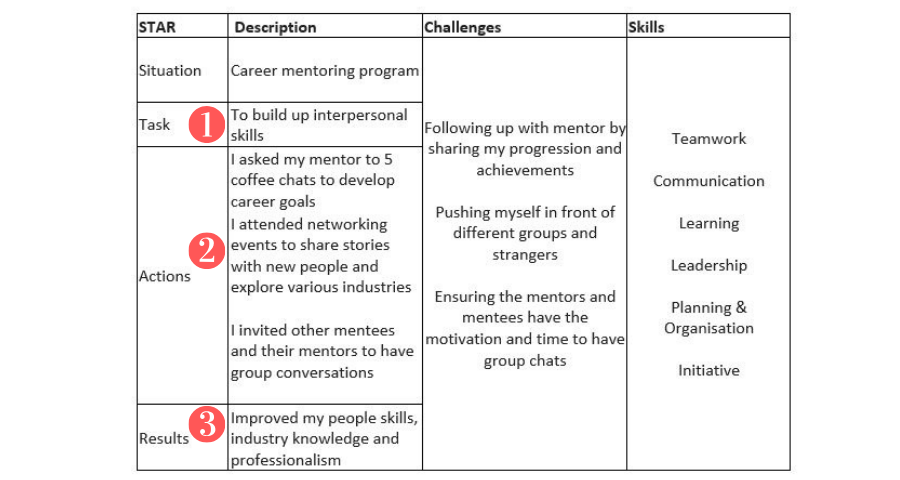
Sample 4: Mentee in mentoring program
Comments 4

  1. Ensure Task description is complete, for example, “To build interpersonal skills and gain insight into an accounting career”.
  2. Pro-tip: after writing your first draft of your STAR examples go back and see how you can summary your dot points to make them even more memorable, this will help you during the interview. See examples below.
  3. Where there any other results? Did the mentoring program and networking lead to any opportunities that you have learnt from?
  • I asked my mentor to 5 coffee chats to develop career goals –> 5 sessions w/ mentor to develop career goals
  • I attended networking events to share stories with new people and explore various industries –> attended 5 networking events in the Accounting and Consulting industries

Sample 5: Industry placement as part of university studies

Comments 5

  1. This STAR example is well written. It covers a range of quantifiable actions.
  2. Results: what tools were used? Unnecessary to say that “Everyone was happy”
  3. Skills: The skills list is almost the same as those in Sample 4, try to find a range of different skills across your examples so you have a range of skills to draw upon (e.g. don’t use the same 5-7 skills for each example).

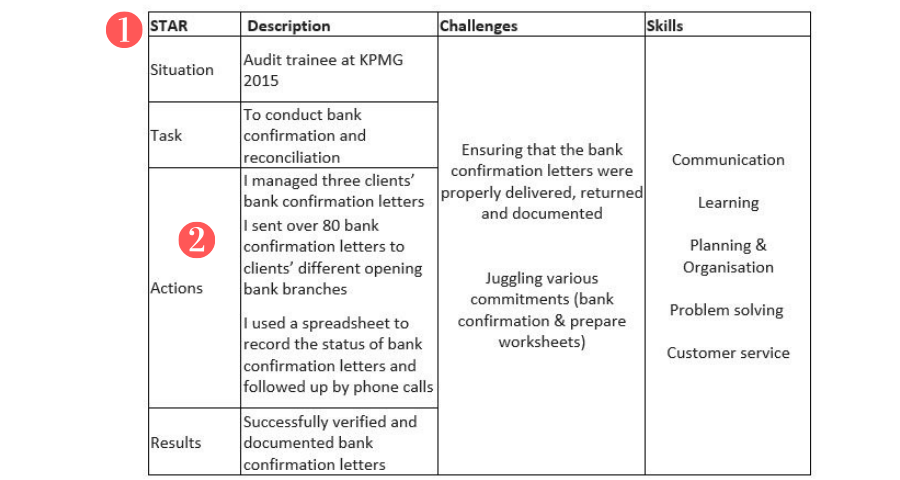
Sample 6: Internship/Vacation work
Comments 6

  1. Again, this example is well written and considers challenges and skills.
  2. Would recommend gone through the wording again and further summarise. For example;
    • I managed three clients’ bank confirmation letters –> Managed 3 clients’ bank confirms
    • I sent over 80 bank confirmation letters to clients’ different opening bank branches –> Sent >80 bank confirms to client bank branches
    • I used a spreadsheet to record the status of bank confirmation letters and followed up by phone calls –> Record status of letters in Excel & followed up with calls

Interviews

Part 1: Sample STAR examples, a detailed guide to writing your own STAR examples

We’ve gone through the basics of the STAR technique but how do you know if your example is good enough? How do you know if you are focusing on the right things?

This post will cover 3 student examples and my tips for making your STAR examples stand out to help you nail interview questions. Each STAR example is in table format, uses dot points and states challenges and skills that were present in the situation.

In Part 1 we will look at STAR examples for a;

  1. University club and society
  2. Case competition
  3. Part-time work

The STAR technique is great because it really helps you to clarify your thoughts and think deeply about the experiences you have had so that you have many strong examples to use in behavioural interview questions.

The below STAR examples come from real students applying for graduate programs, names of companies have been edited out.

Sample 1: University club and society

Comments 1

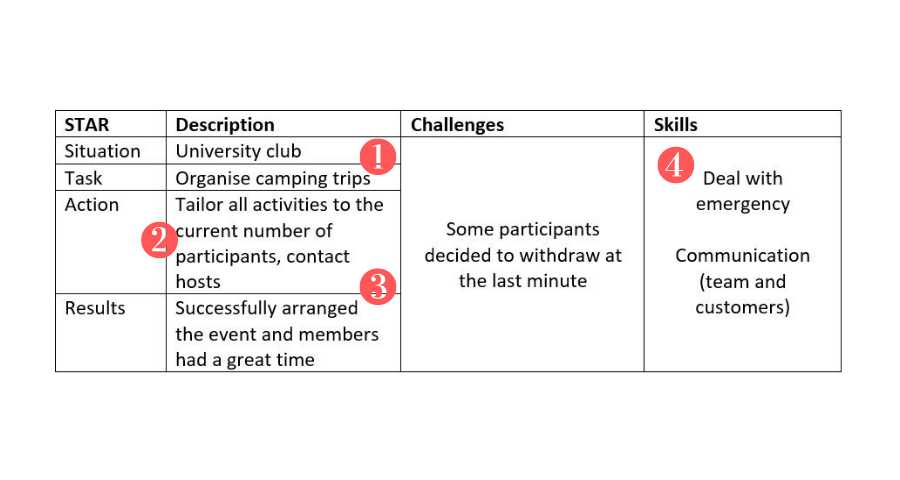
  1. The Situation and Task sections can be very brief, you don’t need to go into too much detail about what the club is or why you have camping trips. When answering an interview question, you can start by saying, “As part of my committee role on the [insert name of club] I was responsible for organising the camping trip…”
  2. Provide additional details in the Action section to ensure that you have thought about all the activities that you performed in situation. 
  3. Quantify Actions and Results if possible. It is always more impressive and makes a better impact when you can state the number of percentage change of your results. Talk about achievements rather than responsibilities but make sure these are true, don’t make numbers up! For example, successfully organised the camp with 50+ people in attendance and came in $500 under budget.
  4. Add more employability skills, aim to have 5-7. Your difference STAR examples will have a range of skills that you can draw upon when answering questions. For example, this STAR example shows budgeting, negotiation skills and flexibility.

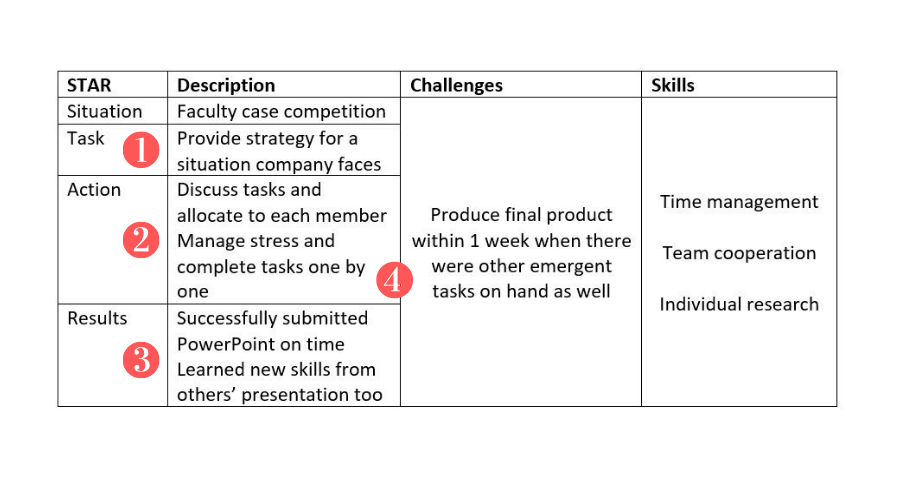
Sample 2: Case competition

Comments 2

  1. Would be useful to give some background into the ‘situation’ that the company faced if relevant to the question. Add a dot point to ensure the situation can be explained concisely.
  2. Action sections can be summarised into “allocate tasks and complete”. What were the specific tasks? For example, research into the company, interviewing stakeholders and performing analysis of financials.
  3. Quantify Actions and Results if possible and aim to have 5-7 employability skills . For example, presentation and verbal communication.
  4. Overall this STAR technique needs to have a few more specific details written down so they can be easily recalled in an interview.

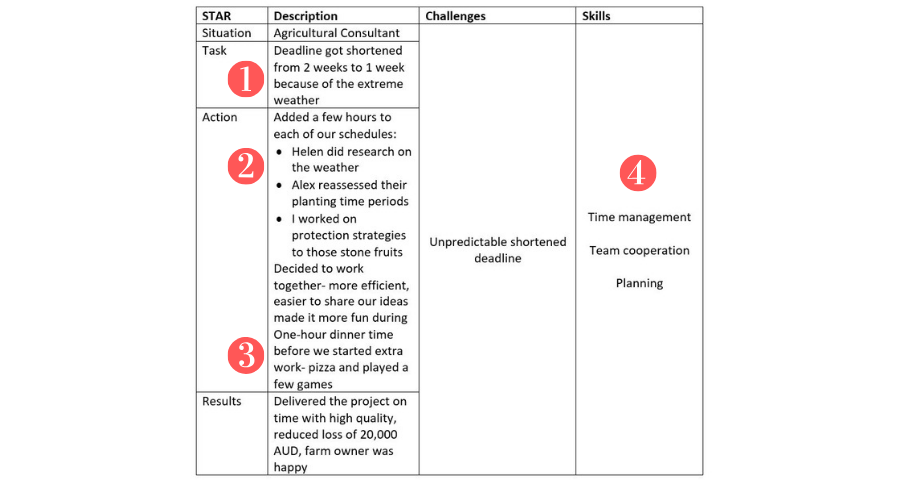
Sample 3: Part-time job

General comment: this STAR example needs to be broader. It focuses specifically on the problem that was faced and doesn’t go into the other requirements of the role. It is as if the STAR example has been written in response to a question like, “tell me about a time you encountered a problem and how you solved it”. Remember you are just using the table to think deeply and remember the key details of the experience which will allow you to draw on any of the different aspects of the scenario when answering a question.

Comments 3

  1. The Task is the shortening of the project deadline, but it does not state what the actual task or project was. In the Task section you might see for example, assess planting periods for a farming client to ensure the protection of stone fruits.
  2. Do not mention other team members by name. Not only does the interviewer not know who you are talking about but if the question is phrase negatively (e.g. when did you work in a group when someone did not pull their weight) calling someone by name might be perceived as having something personal against that person. When answering a question, it is fine to refer to your team members as follows, “we delegated the tasks, one team member research weather pattern, the other planting time period and I assessed protection strategies”.
  3. Remove unnecessary detail. For example, the interviewer does not need to know you had pizza for dinner but it is sufficient detail to say “as we had to work more hours during the week to meet our deadline, we ate dinner as a group and ensured we kept the morale high by working together and sharing ideas”.
  4. 5-7 employability skills . For example, leadership skills, technical skills, diligent and dependable.

In Part 2 we will look at STAR examples for;

  1. Participating in a mentoring program as a mentee
  2. Industry placement as part of university studies
  3. Internship/vacation work

Interviews

Tips for your first graduate job

Firstly, congratulations! If you’ve gotten a graduate role, I’m guessing that you are hardworking, dedicated and want to succeed in your career, even if you are not sure whether the company or your particular area is where you want to be 3 or 5 years in the future. Here are 4 TIPS on how to make your first year of work count and set you up for success. These have been written from a consulting perspective but can easily be applied to any graduate position.

1. Having a positive attitude in your approach to work.

A positive attitude includes; putting effort into your work (no matter how boring or menial the task may be), being on time, being prepared, proactively booking meeting rooms, sending meeting invites, writing meeting minutes and not complaining. These are the ‘easy’ things that require ZERO talent.  They might not improve your technical skills, but they do say a lot about you as a person and form part of your personal brand.

You are guaranteed that there will be boring jobs but having a positive attitude keeps the door open for new opportunities. Here is an example of how having a good attitude opened a door for me. I had some time available between jobs to do some business development work and was working with a senior manager from a different team within the firm to develop a slide pack for potential clients, which detailed our service offerings in that area. I also helped her organise a networking event and chaired a panel, asking questions of various industry experts. These tasks weren’t billable to the client and did not require deep knowledge of the area, but I did get the chance to work closely with the senior manager. She later left the firm to become a director at another one of the big 4 and ended up offering me a job at her new firm because of the business development work we had done together. What may seem like a trivial, boring tasks can often lead to new opportunities if done well.  

2. Understand expectations and performance metrics.

All companies will have some expectations or metrics used to determine how you are performing as an employee. Often, they will have some general guidelines on what the expectations are at each rank (e.g. managers are expected to have strong client relationships, consultant are expected to participate in some client meetings but follow the direction of the manager). There also might be some specific, easily quantifiable metrics such as being 80% chargeable (80% of your time must be spent on work that is chargeable to the client) and not forgetting to submit your timesheet each week. Clarify the expectations for a graduate with seniors or counsellors/mentors to ensure you are on the right track.

3. Establish goals to clearly define your progress.

Set goals around whatever your company values are, for example, our company had 4 different quadrants that are scored in performance reviews. Your goal areas (quadrants) might be different but here are some sample goals to get you started:

  • People: Build a strong team environment and make my team the best place to work
    • Organise a team event, within budget and with maximum attendance
    • Attend 3 recruitment events during the year and speak to >20 potential hires
    • Participate in a volunteering activity through work
  • Market: Networking and learning to interact with clients and colleagues in professional and social setting.
    • Attend 3 networking events (professional learning/interest groups)
    • Understand a system used by the company so you can be the champion in that area and have enough knowledge that I would be able to give a presentation to the team on it
  • Quality: Develop excellent technical skills and professional qualifications in my area
    • Exposure to a programming language (R programming), data visualisation tool (Tableau, Microsoft Power BI)
    • Pass exam _____ by date ____
    • Develop reporting and presentation writing skills complete business writing course
  • Operational: Understand a process and roles in engagement management
    • Track all the budgets for the engagements I work on
    • Send my direct manager a weekly budget update

Ask your seniors what their goals were when they were graduates to help you formulate your goals and get specific when you define your goals. For example, use R programming on 2 engagements and get management feedback on the use of my skills, rather than learn R programming.

4. Reflect on your progress and reassess.

Performance reviews usually happen semi-annually or at each financial year end. Keep an ongoing list of the jobs/projects you have worked on and your progress against your goals so you can easy recall and demonstrate your worth when called upon. These times provide an opportunity for the company to assess your performance and determine how you measure up against your peers, but it is also a good opportunity for you to assess your current work environment and think about the future of your career at the company;

  • Is the team supportive?
  • Do I receive the learning opportunities I need to develop?
  • Is the work still interesting, do I have room to grow?

The first year of work after graduating goes by quickly and it is always a good idea to ensure that you are making the most of your early career.

Career Development

5 minutes to determine clear career values

I recently attended a career values workshop and would like to share a technique I learnt to quickly determine your career values and assess whether you are happy in your current work.

Let’s get straight into it, the steps are:

  1. List 4-6 things that are important to you in terms of career.
  2. Remember a time where you felt on top of your game and really satisfied at work. What 2 feelings did you have at this time? Add these to the list
  3. Go through your list and remove any values that you think are duplicates (does it feel like they mean the same thing?)
  4. Rank your list, with the highest priority value being #1
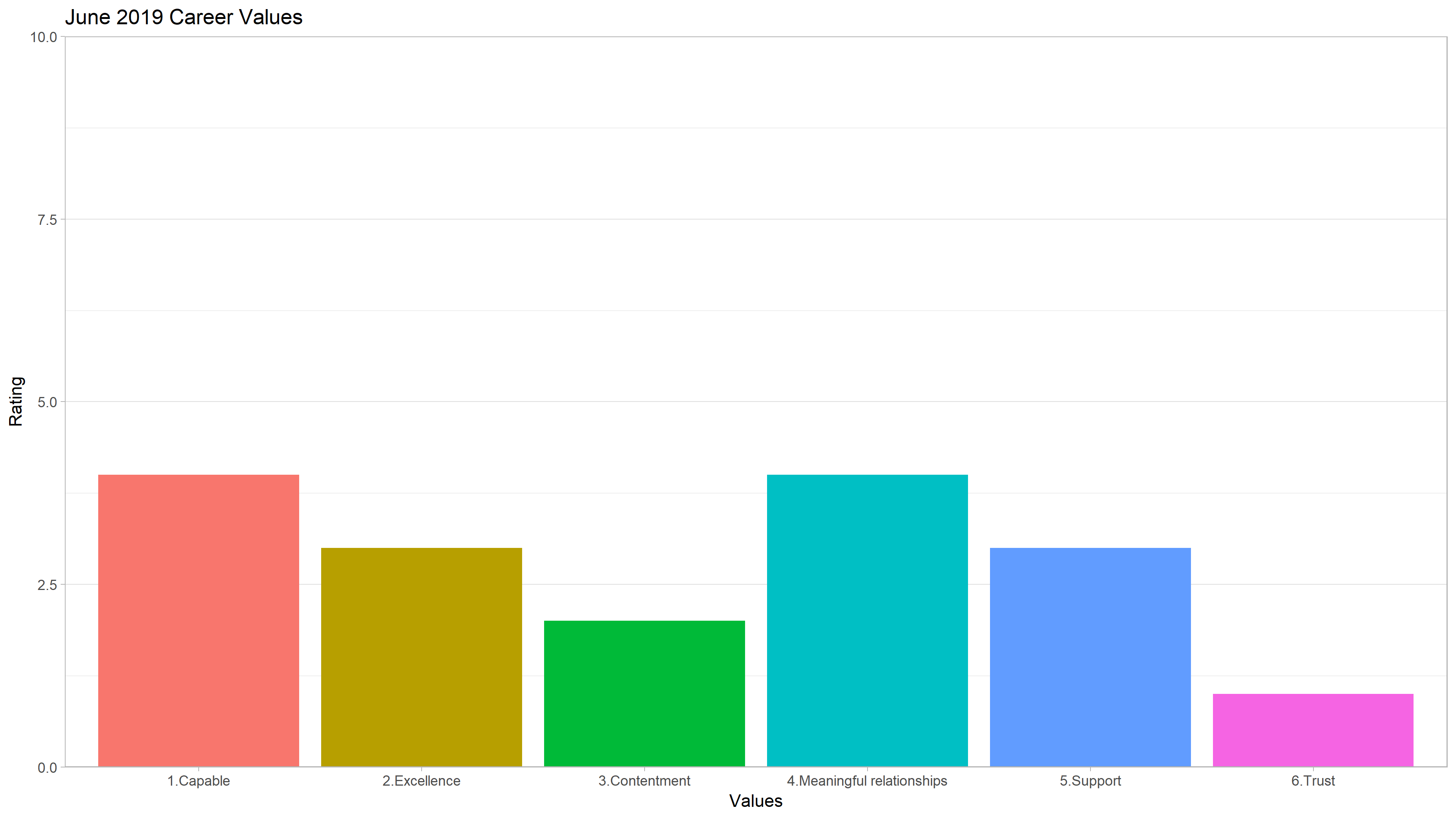
  5. Assess how you feel in your current workplace for each value, giving each a score from 0 to 10, with 10 being the best possible score
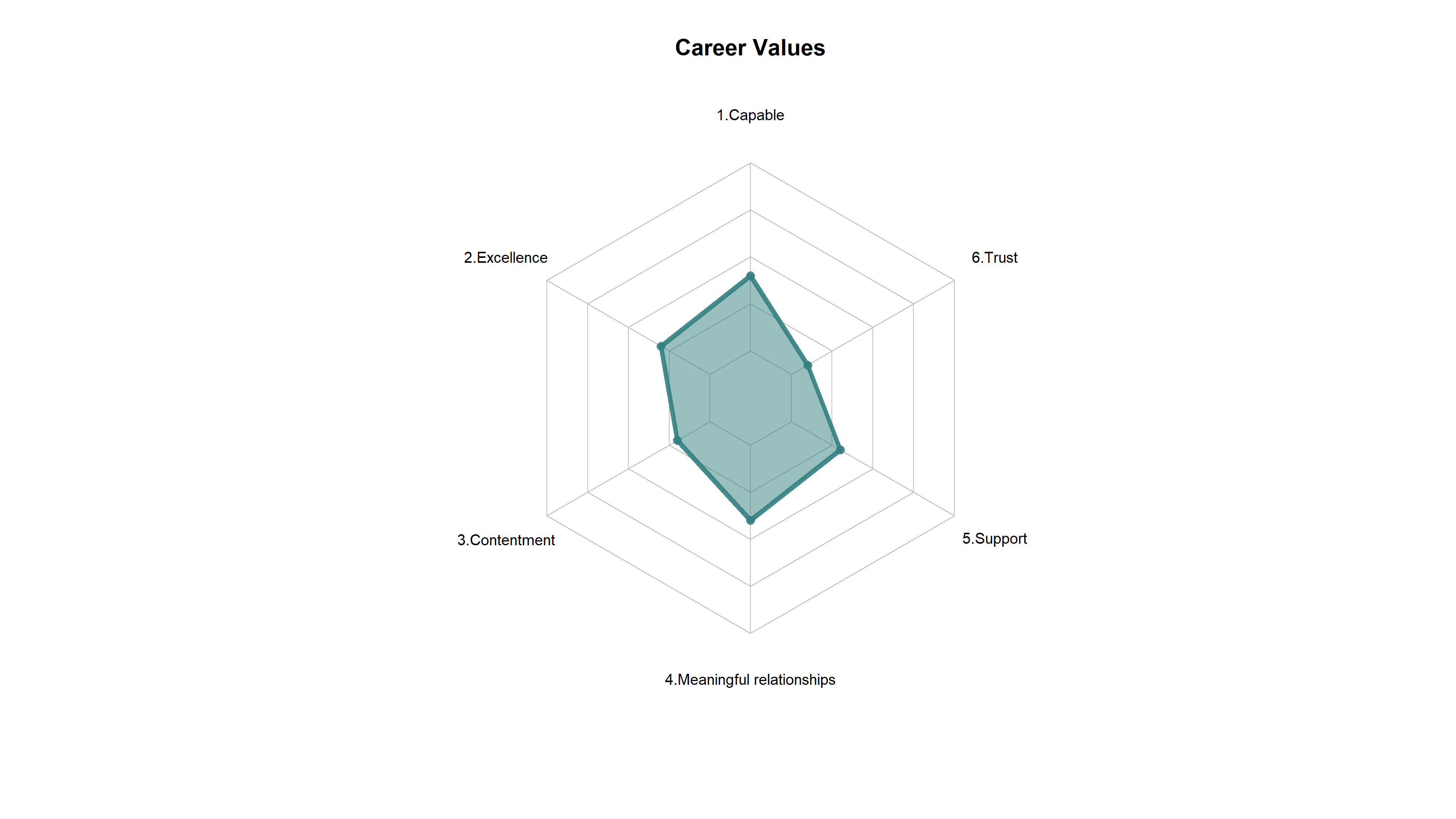
My June 2019 value, as you can see from this graph my value scores aren’t very high!

The trick is to think of your values quickly and go with your intuition or ‘gut feel’ when ranking your values.

This radar graph was created using R-programming and the tutorial here

If you’ve scored some of your highest priority values with low ratings, ask yourself,

“In order to go from a X to a Y what would need to change in my current work situation?”

“What specific requests can I make to ensure there values are met?”

Career values can be both extrinsic or intrinsic in the context of your career and life. Your values will probably change as you go through different life stages and it is useful to review them regularly to assess whether you are content with your work or if something needs to change.

Career Development, Interviews

Have you ever thought about YOUR career values?

There’s so much pressure to get your first job out of university. You have a wishlist of what you want but then you also want to land a job. With more and more students graduating and a tough job market, it’s much easier said than done. It’s always a good idea to think about who you are and whether the particular job or career path suits you. Often you don’t know if you like or dislike something until you try, but here are some key things you should consider when investigating your career options:

  1. Personality type
  2. Interests
  3. Aptitudes
  4. Values

Today’s post will focus on career values and give you an idea of what things might spark career satisfaction for YOU. Career values fall into 3 main categories; Intrinsic, Extrinsic and Lifestyle values.

Intrinsic values (what you put into work)

  • Achievement
  • Independence
  • Relationships
  • Support
  • Helping others
  • Collaboration
  • Helping society
  • Utilizing your skills and background
  • Creativity
  • Variety
  • Being challenge
  • Taking risks
  • Being an expert

Extrinsic values (what you get out of work)

  • Flexibility
  • Time off
  • Travelling
  • Reward(financial compensation, recognition, leadership)
  • Prestige
  • Working conditions
  • Autonomy (worker/entrepreneur)
  • Influence
  • Respect
  • Work environment

Lifestyle values (where you want to live, how to spend your leisure time)

  • Leisure
  • Job security
  • Ability to support your hobbies, mortgage

What values are important to you? Send me a message at earlycareerme@gmail.com!

We’ll explore how to determine which career values are most important to you in future posts.

Interviews

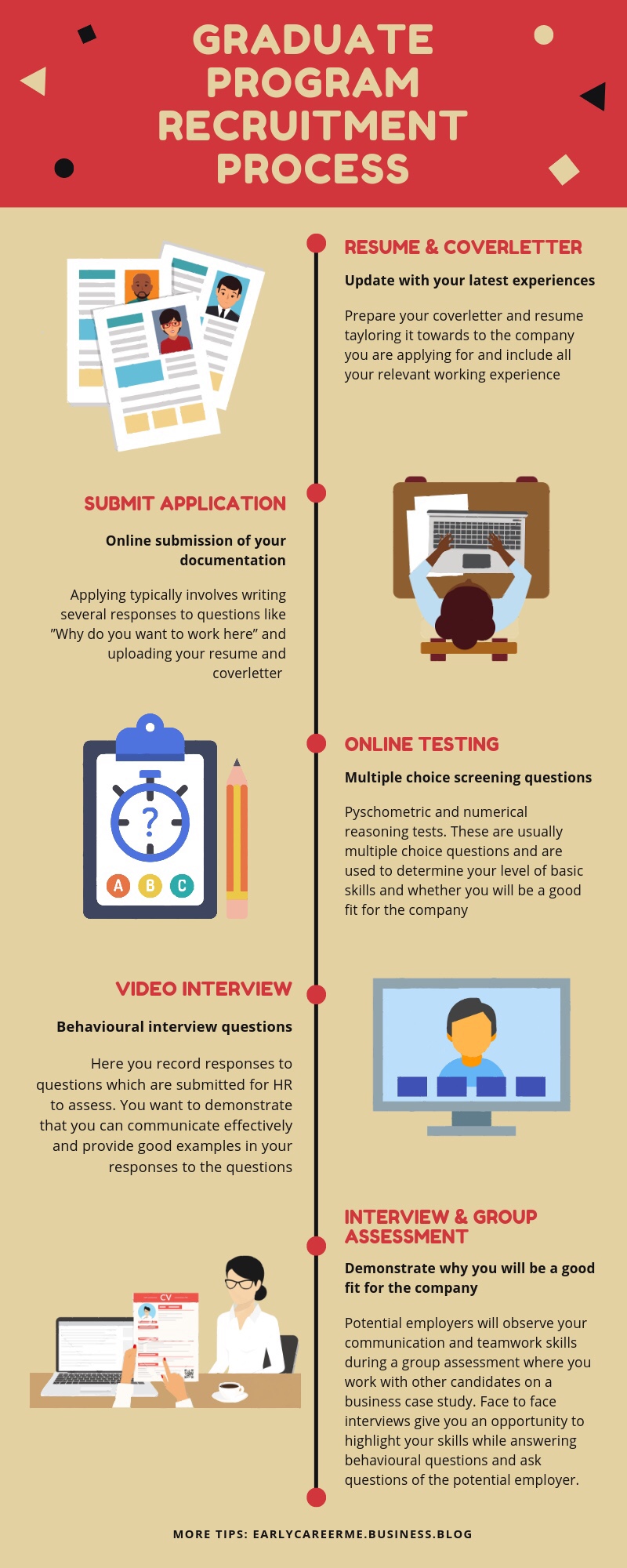
The graduate program application process: from updating your CV to the final interview

Today I’m sharing from my experience the graduate recruitment process for the business / commerce industry. The actual process depends on the size of the company and how many applicants they have. Generally the more applications, the more steps required to filter out the best candidates. Companies might hire on a rolling basis – this means that they start reviewing and processing applications when they are received, rather than waiting to the deadline date for submission, so it is always a good to submit your applications early.

The time for the whole process to go from start to end depends on the company, often it can be a couple of weeks before you move through each stage, especially at the initial stages of testing and video interview stage as it takes human resources (HR) a while to go through all their applications. In Australia the majority of the big companies open their applications around March and April, and these are usually for positions in the following year. E.g. applied in March 2019, got an offer in April 2019, will start work in January 2020.

Interviews

The STAR Technique

20190508_085130_00004364618862603628055.png

If you have started to prepare for graduate program interviews, it is likely that you have already come across the STAR technique. This post is a quick-guide to get you started with the STAR technique

In this article we will cover the following:

  • What does the STAR acronym stand for and how to structure one using an example
  • How to choose your examples
  • How to apply the STAR technique to behavioural interview questions

The STAR technique is a method to help you structure answers for behavioural interview questions, which include questions like “Tell me about a time you showed initiative“.

The benefit of using the technique is that it forces you to use an example from your past experience to answer the question, rather than make a generic statement like “I work hard and am a creative team player”.

In behavioural interview questions, the interviewer wants to know how you have shown the particular trait in the past, which provides an indication of how you will perform in the future.

STAR is a valuable tool because often large companies, like the Big 4 Accounting firms, encourage graduate applicants to answer interview questions using the STAR structure.


The STAR structure

Situation: what was your role or responsibility?

Task: what did you do in this specific example?

Actions: what actions did you take to complete or solve the task?

Result: what were the results of your actions?

Here is an example of how I would apply to the STAR structure to one of my experiences from university. Other student STAR examples can be found here.

Some things to consider when writing your STAR examples;

  1. Keep your descriptions concise. Use dot points and avoid writing paragraph descriptions. The aim is not to write a script you can later recite but rather to assist you in remembering the key aspects of your experiences
  2. Think of any challenges you faced during the experience and write them in the third column. This helps you to think about any ‘negatives’ in the situation and how you either fixed them or learnt from them. Good examples of challenges include miscommunication, tight deadlines and team members not doing their fair-share of the work.
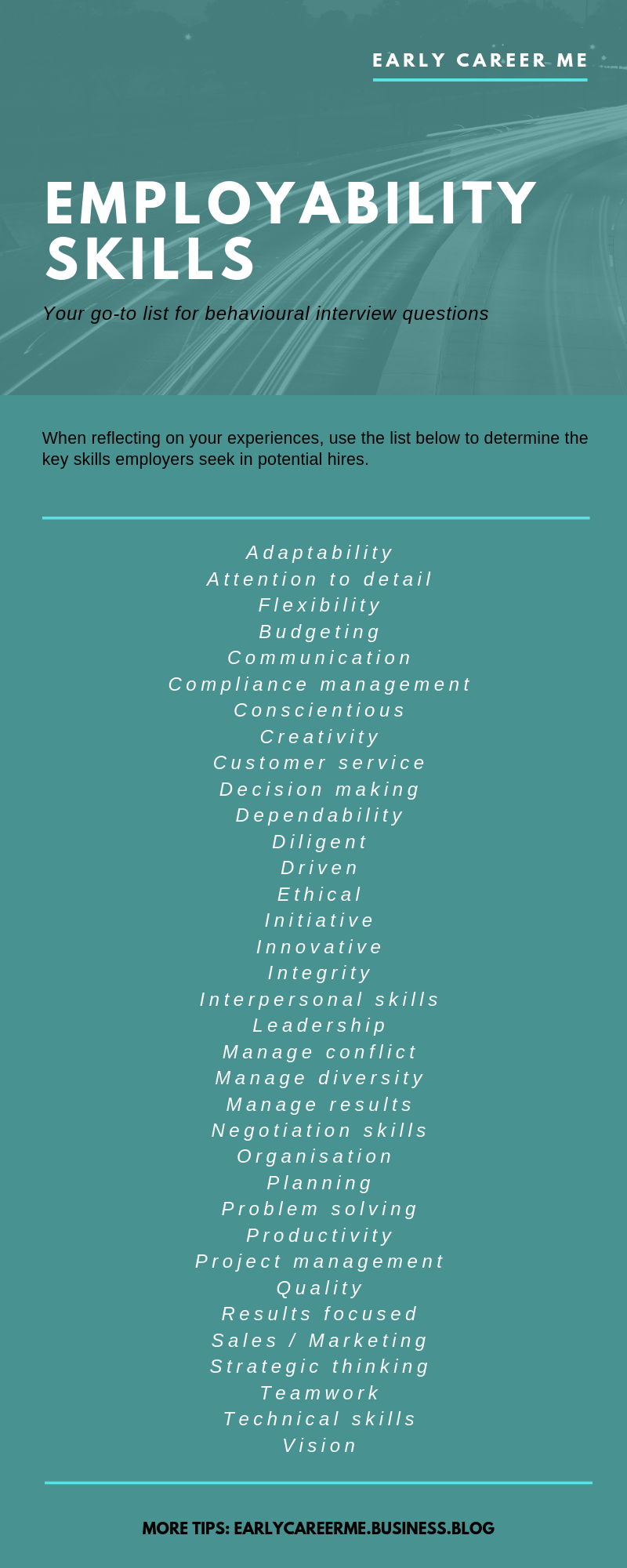
  3. Key skills list. Find a list of transferable employability skills and write down any of the skills that you displayed during the experience.

How do I choose my examples? How many examples should I have?

Start by reviewing your resume and looking at the key positions and roles you have held. Here are some examples of the situations you might use;

  • Studies: large assignments, group work
  • Extra-curricular activities: sports teams, committee or student member of a university club/society
  • Volunteering: university open day, mentoring studies
  • Part-time work: retail sales, tutoring
  • Internships / Vacation work

Come up with a range of examples that show you are a well-rounded individual with transferable skills (for example, show volunteering, extra-curricular activities, not just ‘work’ related experience). Going into a graduate position, you are not expected to be a technical expert, employers want to see that you have the capability to develop your skills.

6 -7 examples should give enough coverage to answer most types of behavioural questions

My biggest tip for behavioural questions is to start with the answer first. There are numerous variations of behavioural questions and chances are that in an interview you will get a question you have not heard of before and prepared for.

Rather than trying to prepare answers for all the behavioural questions you can find online, start by preparing 6-7 STAR examples. Once you have prepared your examples in the format above, you can start answering questions by tailoring your STAR example to the question, which is a much more efficient way to prepare.

Here is an example of how to tailor the answer to the question using my STAR example from above.


Behavioural question 1: Tell me about a time when you had to adjust to changes over which you had no control. How did you handle it?
Answer approach 1: Using my experience above, I would structure my answer to say that as it was busy during the semester, some committee members had competing priorities so we had to balance the workload and step in where needed. I would then go on to talk about how I did this.


Behavioural question 2: Tell me about a time you faced a problem while working in a team.
Answer approach 2: A challenged I faced when organising the camp was that the committee members were busy during the semester which placed pressure on our ability to organise the camp.